
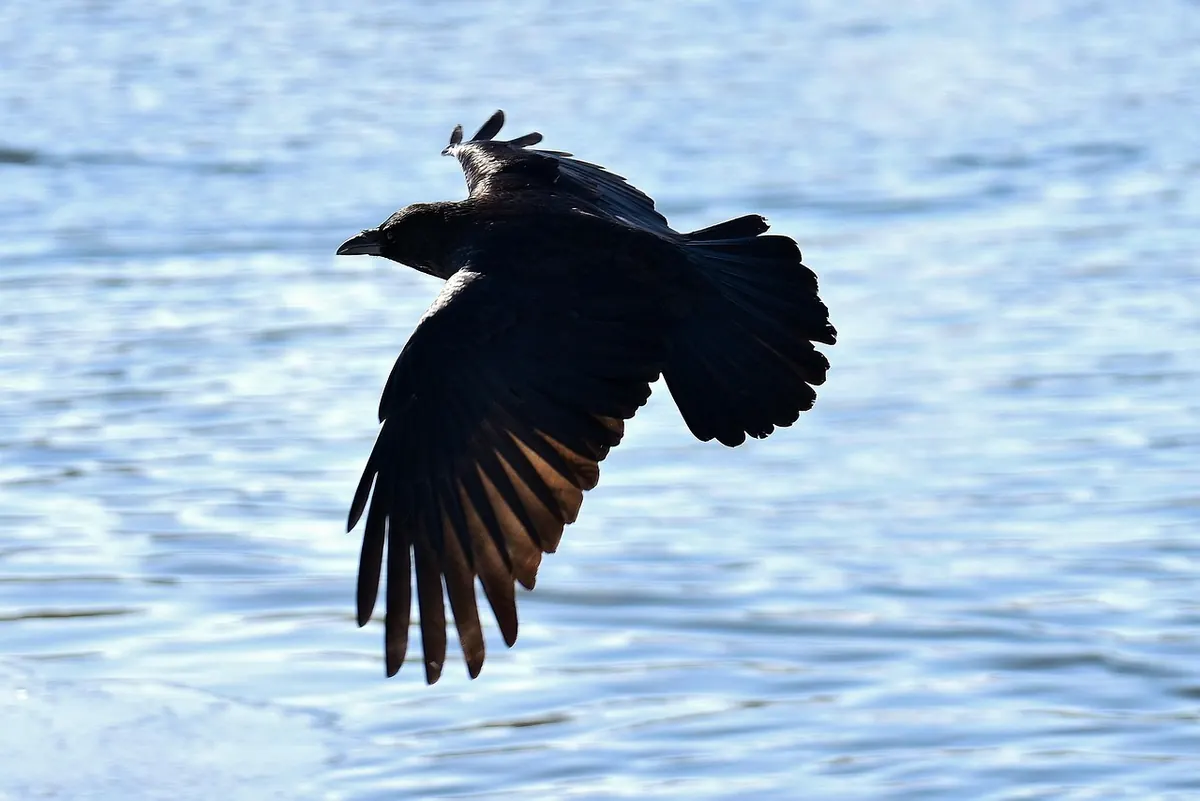

On a still January afternoon, a single deep croak carries across the moor. Then another, further off, and another. By the time the light has gone amber and started to fail, a dozen ravens are moving on the same line, high and purposeful, heading for the same wood. It happens every winter across Britain, and most of it goes unnoticed — which is part of what makes finding a roost so satisfying.
Why ravens gather at dusk in winter
Ravens are not colony birds. Through the breeding season a pair holds a territory and drives off intruders, and many pairs keep that territory all year. Winter shifts the social rules. Birds without a territory — mostly younger, unpaired ravens — drift more widely, and as the light drops they funnel towards sites that have been used for the same purpose, in some cases for many decades.
The usual explanations for communal roosting are straightforward. A crowd means more eyes watching for trouble, and a bird in the middle of a group of thirty is harder to surprise than one on its own. Roosts also act as an information exchange: a raven that has found a carcass or a good feeding area may lead others there, and a newcomer arriving at dusk can pick up on where the rest have been. Shelter matters too — a dense stand of conifers or a cliff face out of the prevailing wind is warmer than an exposed branch.
Residents, wanderers and pairs
Not every raven roosts communally, so don't expect a single tidy explanation. Established pairs often stay close to their own patch and roost alone or as a pair. Young birds travel further and gather in larger groups. A roost on a lowland estate may hold different birds from one on a Welsh hillside or a Scottish glen, and the numbers at any site can change through the winter as pairs begin to form and break away.
Reading the sky: how to find a roost
You rarely stumble on a raven roost. You work it out, usually over several evenings in the same place. Start with the birds themselves.
- Flight lines. Watch for ravens crossing high and steadily in one direction in the last hour of daylight. They are not feeding or displaying; they are commuting.
- Converging calls. Listen for the deep, hollow kronk coming from more than one direction at once, getting closer together as the light fades.
- Pre-roost gatherings. Ravens often assemble nearby first — on an open field, a ridge or a line of pylons — before moving to the roost trees. Tumbling and chasing here is play and pair-formation as much as anything else.
- Likely sites. Tall conifers, mature pines at a woodland edge, quarries, sea cliffs and crags all appeal. Traditional sites are often the tallest, most sheltered thing around.
- Local knowledge. County bird reports, local bird groups and reserve wardens often know where the nearest winter roost is. Ask before you spend three evenings guessing.
Once you have a direction, use a fixed landmark — a pylon, a church tower, a distinctive tree — and note the time birds pass it. Come back a few evenings later and check whether they pass the same point at the same time. That is how a flight line becomes a location.
Timing your visit
Arrive at least forty-five minutes before sunset and plan to stay for half an hour after the last bird settles. Midwinter is the peak: December and January give you the biggest gatherings and the earliest arrivals. From February onwards, pairs start to peel away and the roost shrinks, though it can still be worth watching.
Weather matters more than most people expect. Still, dry evenings with high cloud or a clear sky give the best display — birds arrive early, call a lot and move around between trees. Wind and driving rain push them in fast and low, or shift the roost to a more sheltered stand. Frosty, quiet evenings are the ones to clear your diary for.
Watching without disturbing them
Ravens are among the wariest birds in Britain, and a roost is where that wariness pays off for them. Push in close and you will either empty the wood or watch a silent, edgy gathering that tells you nothing. Distance is the whole technique.
- Watch from a public footpath, a road or a viewpoint. Never cross private land without permission, and never open a gate to get a better angle.
- Keep a few hundred metres back where the ground allows, and use binoculars or a scope. Good optics beat a good position every time.
- Stay low, keep still and wear dull colours. Avoid cresting a skyline where arriving birds will see your silhouette.
- Keep quiet. No calls played back, no clapping, no whistling to get a reaction.
- No drones and no flash photography. A torch on the walk back is fine, ideally with a red filter and pointed at the ground.
- Keep dogs on a lead and well away from the trees.
- If birds lift off, circle and resettle elsewhere, you are too close. Retreat a hundred metres and wait. If they keep moving, leave it for another evening.
All wild birds in the UK are protected by law, and there is no reason to get near a roost in any case. The best views come from being overlooked rather than noticed.
What happens, minute by minute
The first arrivals usually come in quietly, one or two birds dropping into the top of a tree and sitting still. Then the pace picks up. Small groups appear from different directions, calling as they come, and the noise builds into a low, rolling conversation across the treetops. Birds shuffle between branches, swap positions, chase each other in short bursts and tumble in the air — half-rolls and dives that look reckless at speed and are perfectly controlled.
Then, quite suddenly, it stops. Around full dark the calling fades to the odd muttered croak and the birds settle. Departure in the morning is the opposite: no mass exit, just birds slipping away in ones and twos in the first grey light, heading out to feed. That is often the best moment to note which direction they go.
Notes worth keeping
Write down the date, the time of sunset, when the first bird arrived, your best estimate of the peak count, the weather and wind direction, where they settled and where they left at dawn. An approximate count is far better than none. Repeat visits through a winter will show you which nights are big, which are quiet, and how the roost changes as spring approaches.
Your first roost visit, planned
Pick a site you can reach without a long walk in the dark, ideally one where you already know the paths. Arrive an hour before sunset, park considerately, and walk to a viewpoint that puts the roost trees between you and the last of the light. Take binoculars, a notebook, a flask and more layers than you think you need, plus a torch for the return leg. Settle in, stay put, and let the birds come to you.
If nothing much happens on the first evening, don't give up on the site. Weather, wind and the birds' own movements all change the picture, and a roost can shift by half a mile from one week to the next. Two or three visits will usually tell you whether you have found something real. When you do get it right — thirty ravens calling in a fading sky, then silence — an hour of cold feet feels like a bargain.
Photo: xcazmm / Pixabay
Related posts
More stories you’ll love reading