


There is a moment most birdwatchers remember: a big black shape crosses the valley, someone says "raven" with total confidence, and someone else with a few hundred more hours in the field says "carrion crow". Nothing takes the shine off a sighting faster.
The awkward truth is that ravens and crows overlap in size, share a silhouette from certain angles, and both make sounds that can seem wrong at distance. None of the mistakes below are stupid. They are the ones nearly everyone makes. Knowing them in advance just shortens the learning curve.
Mistake one: judging size with nothing to compare it to
A lone black bird against an empty sky tells you almost nothing about scale. A distant raven can look like a nearby crow. A nearby crow, seen through binoculars that flatten the scene, can look enormous. Size only means something next to an object whose size you already know.
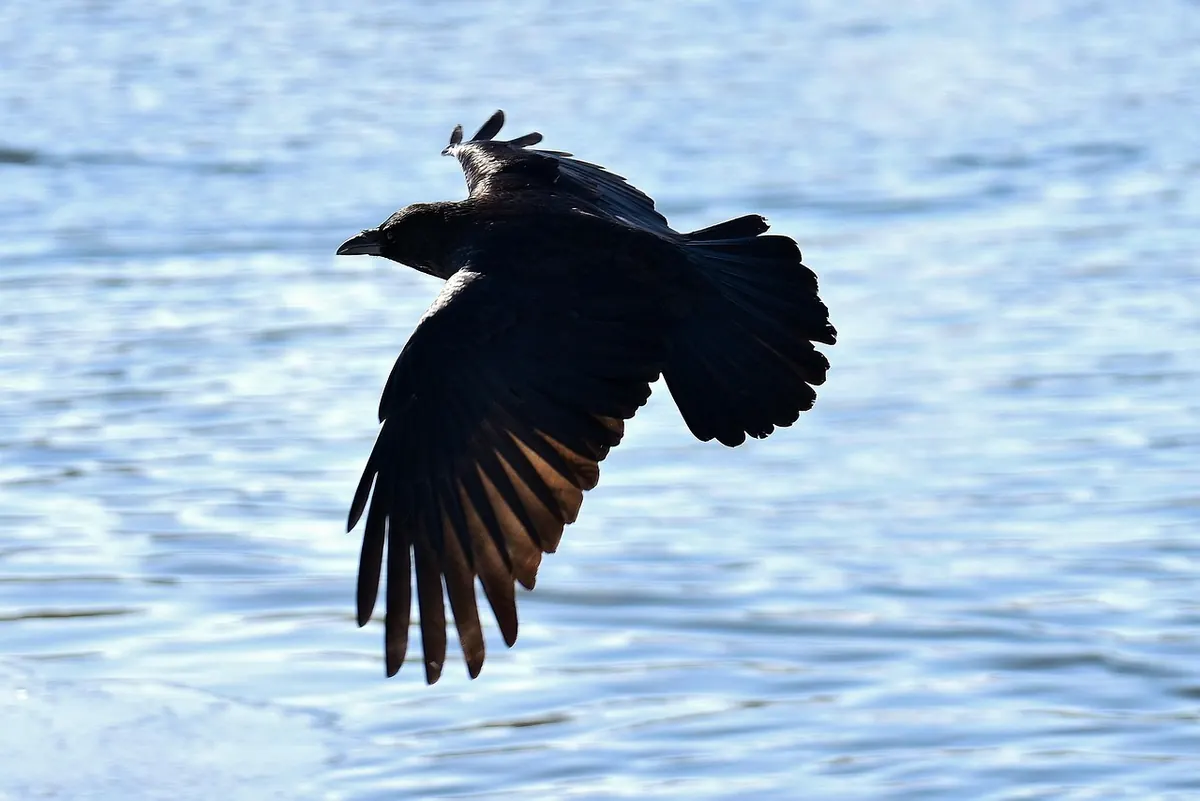
Use landmarks. A fence post, a gate, a parked car, a sheep, a picnic bench. Ravens are roughly buzzard-sized in the air, but proportioned differently: a longer tail, longer and narrower wings with splayed "fingers" at the tips. Carrion crows are a good deal smaller, nearer a woodpigeon with attitude. If the bird is clearly smaller than a buzzard and you have nothing else to go on, slow down before committing.
Practise deliberately. Spend ten minutes watching crows on a sports field where you know the distances, then look at a bird twice as far away and ask what it would look like. Your eye needs a baseline before it can judge anything.
Mistake two: turning one call into a verdict
The deep, resonant kronk is one of the best clues going. It carries further than you expect and has a hollow ring that a crow's caw does not quite match. But a single call heard once, at distance, is a thin basis for a record.
- Distance strips the tone. A raven half a kilometre away can sound thin and clipped, losing exactly the resonance you are listening for.
- Crows can sound hoarse. A carrion crow with a cold-sounding caw, or a rook calling from a treetop, can suggest something bigger than it is.
- Ravens do not only kronk. They knock, bubble, gurgle, click and mimic. A bird making an odd noise is not automatically something else.
So if you hear a call, look for the bird. If you cannot find it, write "raven or crow" and move on. That is a perfectly good note. An honest gap in your list is worth more than a confident error you carry for years.
Mistake three: reading tail shape from a bad angle
The wedge tail is genuinely useful, and it is the feature most beginners reach for first. The problem is that it is only clear when the bird is gliding or soaring and you are seeing it from below or behind. In steady flapping flight a raven's tail can look almost square, and a crow banking hard into a turn can briefly look forked. One glimpse of a tail proves very little.
What to add in support
Wingbeats first. Ravens beat their wings more slowly and deeply, with a deliberate, almost lazy rhythm. Crows are quicker and springier. Then the wings themselves: a raven shows long, splayed primary "fingers" at the tips, while a crow's wing looks blunter and more rounded. Finally, the habit. Ravens glide for long stretches and often look as if they are enjoying it; crows flap more steadily from one place to the next.
Mistake four: overlooking the head and throat
This is where the best views are won. Ravens have shaggy, pointed throat feathers known as hackles, and they show beautifully when the bird calls or turns into a breeze. The head looks heavy and slightly flat-crowned, with a stout bill that curves gently and carries bristles at the base. A crow's head is neat and rounded, its bill shorter and straighter, its throat smooth.
At long range, the hackles read as a scraggly beard. It is a subtle thing, but once you have seen it on a bird you have already identified by other means, you will spot it again.
A quick checklist for a bird in view
- Throat: shaggy hackles or smooth?
- Bill: heavy and arched, or short and straight?
- Tail: wedge or fan, and only while gliding?
- Wings: long fingered tips or rounded?
- Flight: long glides and slow beats, or steady flapping?
- Company: a pair, or part of a loose flock?
You should be able to tick three of those, not one.
Mistake five: ignoring behaviour and company
Ravens are often in pairs, and they are enthusiastic about it. Soaring, tumbling, half-rolling, chasing each other along a ridge: that playfulness is a strong hint. They also tend to be wary, keeping their distance from people and slipping away over the skyline. Crows are the opposite in temperament. They gather in loose flocks on fields, drop onto landfill, queue on park railings and tolerate you at close range.
Habitat counts too, though less than it used to. Ravens favour sea cliffs, upland crags, quarries and large woodlands, and they have been spreading into towns and lowland areas in recent decades. Crows are simply everywhere. Do not dismiss a bird purely because it is in an unexpected place, but do let the setting shape how carefully you look.
Mistake six: forgetting the rest of the black bird cast
Beginners tend to sort black birds into two boxes. There are more.
- Rook: colonial, bare greyish skin at the base of the bill, shaggy "trousers" on the legs.
- Jackdaw: noticeably small, silvery-grey nape, pale eye, fond of chimneys and church towers.
- Hooded crow: grey body with black head and wings, seen in Ireland, western and northern Scotland.
- Chough: red bill and legs, acrobatic flight on coastal cliffs and in the hills.
- Buzzard: the classic confusion for a distant soaring raven, with broader wings, a short tail and a mewing call.
Buzzard is the one that catches people most often. A soaring bird with fingered wings is not automatically a raven, and a raven gliding with its wings held in a shallow V is not automatically a buzzard.
A field routine that keeps you honest
Work to a three-feature rule. Before you say the word out loud, you need three independent features, and at least one of them structural: head shape, bill, hackles, wing tips. A single feature, however striking, is not enough.
Then slow the process down. Watch the bird for a full thirty seconds before reaching for a conclusion. Note the flight style first, because it is the easiest thing to catch. Compare the size against something on the ground. Listen for the call. Only then drop into the fine detail of the head and throat, which is what seals it at close range.
Write down what you saw while it is fresh: date, site, weather, what the bird was doing, and how sure you are. If you can, sketch the silhouette or record the call. When a record matters, send it to your county bird recorder or local bird club, and be honest about the quality of the view. "Probable raven, seen briefly, tail not clear" is a useful contribution. "Raven" when you saw a black shape at half a mile is not.
Finally, accept that some birds get away. Ravens are big, but they are also distant, fast and often silhouetted against a bright sky. Getting most of them right, most of the time, is the whole game.
Photo: 377053 / Pixabay
Related posts
More stories you’ll love reading