


Ask most people to picture a raven and they will describe a crow. Fair enough. The two are close relatives, they share the same glossy black plumage, and for much of the year they turn up in similar sorts of places. But get a proper look and the difference stops being subtle. Ravens are enormous beside crows, they sound like something out of a folk tale, and they spend their time doing things crows rarely bother with: soaring, tumbling, and croaking from a great height. Here is how to tell them apart without reaching for a book every time.
Start with size, but be careful
Size is the most useful clue and the easiest to get wrong. A raven is roughly the size of a buzzard, with a wingspan that can approach the width of a small car. A carrion crow is nearer a woodpigeon, though longer-tailed and leaner. Perched, a raven looks heavy: thick neck, solid body, legs that seem to be holding up rather more bird than they should.
The catch is that size means nothing without a comparison. An isolated crow on a distant ridge can look very convincing. Use whatever else is in the frame. If a crow lands beside the bird you are watching and it suddenly looks half as big again, you have your answer. If a buzzard drifts over and the two look like relatives, you are watching a raven.
Shape: bill, head and throat
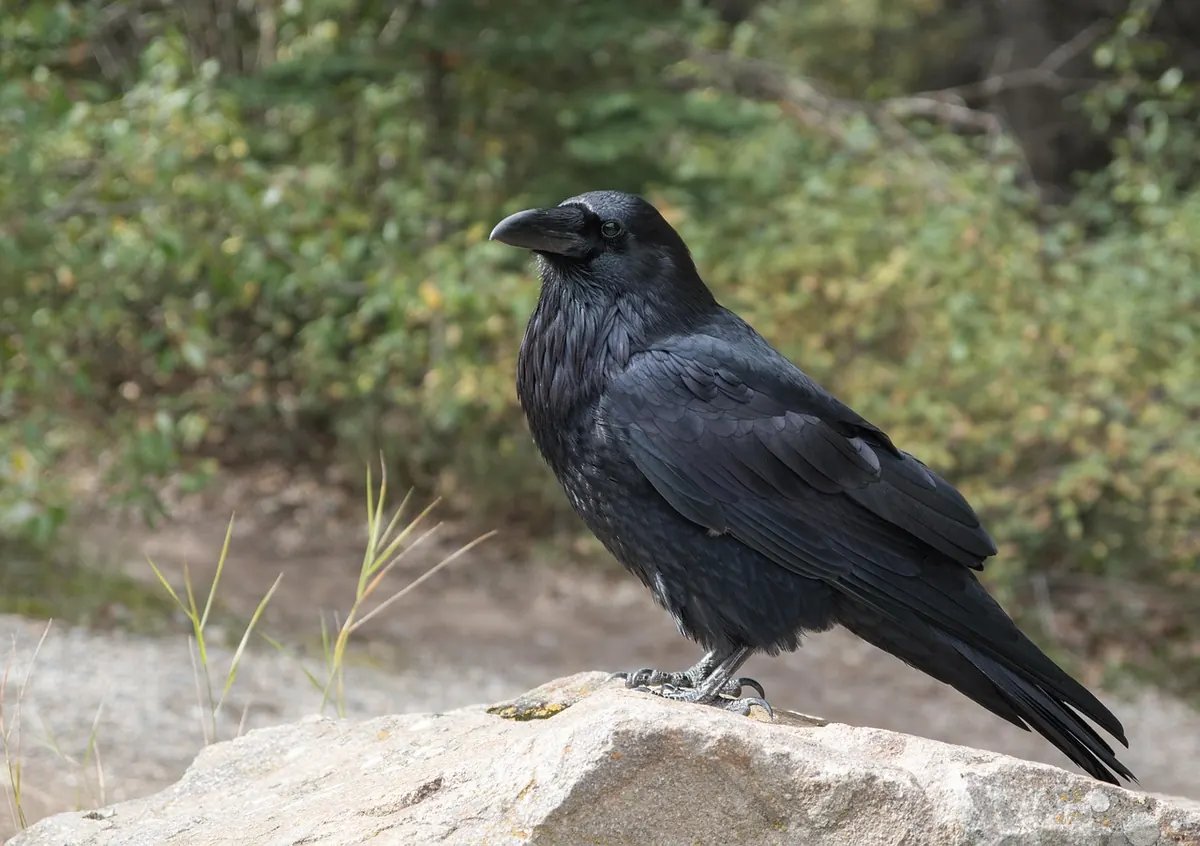
Ravens carry a lot of hardware around the face. The bill is long, deep and clearly curved along the upper edge — a hooked chisel rather than a spike. A crow's bill is straighter, thinner and altogether more modest. Seen head-on, a raven's bill can look almost too big for the bird.
Then look at the throat. An adult raven has shaggy, pointed feathers there, usually called hackles, which hang like a loose beard. They are most obvious when the bird calls or turns side-on to you. A crow's throat is smooth and tidy by comparison. The raven's crown also looks flatter, giving a longer, more sloping head profile, while the crow's head is rounder and more domed.
Worth noting
Young ravens can look scruffy and brown-tinged in strong light, with a less pronounced beard, and they sometimes look oddly long-legged. If a bird looks wrong and you cannot quite commit, stay with it for a few minutes. Ravens rarely sit still for long, and the voice will usually settle the matter.
The tail tells you plenty
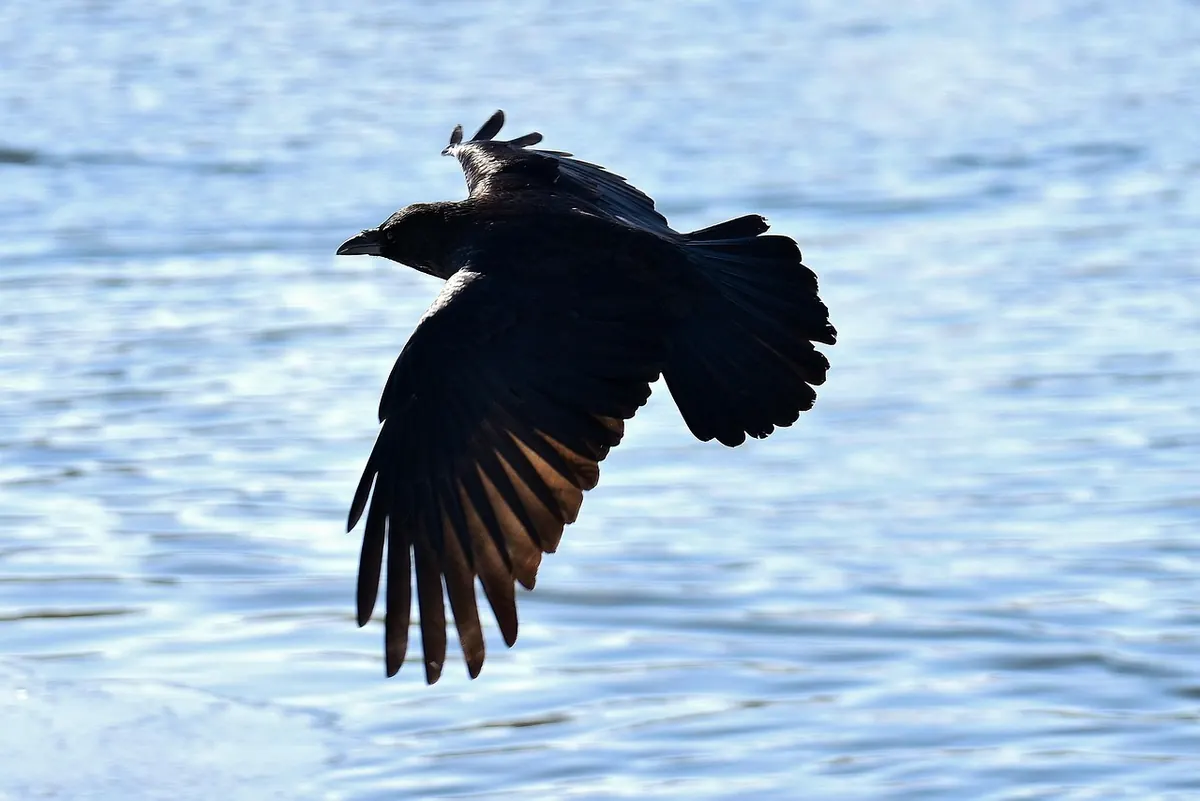
This is the single most reliable shape clue, and it works at surprising distance. A raven's tail is long and wedge-shaped, tapering to a point or a diamond, and it is obvious both perched and in flight. A carrion crow's tail is shorter and ends in a blunt, rounded fan, as though it has been trimmed with a ruler.
On a perched raven, the tail extends well beyond the folded wingtips and often droops slightly, giving the bird a long, back-heavy outline. A perched crow looks compact and stubby by contrast, its tail barely clearing the wings. Once you have seen the two silhouettes side by side, you will not confuse them again.
Voice: the quickest confirmation
If you hear a deep, hollow, resonant kronk or pruk that seems to come from somewhere much larger than a crow, you are almost certainly listening to a raven. The call is rounded and woody, often with a rolling quality, and it carries a long way across a valley. Ravens also produce knocking, clucking and honking sounds, and they are capable mimics, so do not assume every strange noise is something else.
A carrion crow is harsher and flatter: the familiar dry caw-caw-caw, repeated with little variation. Ravens often call in flight or from a high perch, whereas crows happily shout from a rooftop, a goalpost or the top of a bin. Learn the crow's voice thoroughly first. It is the baseline against which the raven sounds so impressive.
Flight and habits
Watch how a bird moves and you will often know before you see any detail. Ravens glide on flat, broad wings with the wingtips splayed out like fingers, and they soar for long spells without flapping. Their wingbeats are slower and deeper than a crow's, and they frequently tumble or half-roll in display, folding their wings and dropping with a rush before pulling out.
Carrion crows flap more steadily and more quickly, with broader, more rounded wings, and they rarely soar for more than a few seconds. They also gather in flocks, especially in winter and at communal roosts, while ravens are usually seen in pairs or small family parties, patrolling a ridge, a cliff line or a stretch of moorland. Ravens are commonest in the west and north of Britain and in Ireland, though the population has been spreading eastwards for decades, so an inland raven is not the shock it once was.
Quick field checklist
- Size: buzzard-sized against woodpigeon-sized.
- Tail: long wedge or diamond against short, blunt fan.
- Head: heavy hooked bill and shaggy throat against slim bill and smooth throat.
- Voice: deep resonant kronk against dry, harsh caw.
- Flight: long glides on fingered wings against steady, quicker flapping.
- Company: pairs and family groups against flocks and roosts.
- Jizz: heavy, shaggy and unhurried against neat, compact and busy.
Practising in the field
The fastest way to learn the difference is to watch crows properly for a week. Pick somewhere you know them well — a park, a car park, a field edge — and note the tail shape, the wingbeats, the call. Once the crow is fixed in your mind, a raven will stand out almost immediately, the way a goose stands out among ducks.
Then go where ravens are reliable: a coastal headland, a moorland edge, a quarry or a valley with crags. Stand still, scan the ridge line, and listen. If you get a bird soaring with splayed wingtips, check the tail first, then wait for the call. Recording the sound on a phone is a useful habit, and noting the date and place builds a picture of what is around your patch over the seasons.
A last piece of caution: distance flattens everything. A raven half a mile away on a dull day can look exactly like a crow, and a crow against a bright sky can look enormous. If you are unsure, say so on your records. A sighting you have reasoned your way through is worth far more than one you have talked yourself into.
Photo: connie_sf / Pixabay
Related posts
More stories you’ll love reading